
 About Us
 News
 Team
 Talent Development






















 Thought Leadership
 Blogs
 Events & Webinars
 Case Studies
 Video Case Studies
 Whitepapers
 Publications
 Visual Gallery
 Media Coverage
 Press Release
 User Groups

01. The business problem
A global pharmaceutical company is moving its analytics platform from Amazon Athena to Snowflake. Its data lake on Amazon S3 holds Parquet tables registered in the AWS Glue Data Catalog, and Athena serves reports that teams in several regions rely on. In the end state, Snowflake is the main platform and Glue is decommissioned. Until then, legacy Athena reports must keep running until each one is moved, and a separate ETL pipeline must keep loading data the whole time.
A big-bang migration would mean copying the lake into Snowflake, rebuilding every report, and switching off Athena in one go. That would put validated reporting at risk. During the overlap, it would also create a second copy of regulated data, with its own reconciliation and audit trail.

02. Options we considered
We compared five approaches. Only one kept a single copy of the data, protected legacy reports during the move, and ended without Glue.
| Option | Data copies | Legacy Athena reports | End state | Verdict |
|---|---|---|---|---|
| Load the lake into native Snowflake tables | Two during the move | Safe, but pipelines run twice | Snowflake only | Rejected: duplicate regulated data |
| Snowflake external tables over the existing Parquet | One | Safe | Still depends on Glue | Rejected: weak consistency, no exit from Glue |
| Iceberg with Glue as the permanent catalog | One | Safe | Built on a service being retired | Rejected as end state; kept as the bridge |
| Iceberg with Horizon from day one | One | Break: Athena can’t read tables without Glue | Snowflake only | Rejected: reports break before they are migrated |
| Glue as a bridge, Horizon as the destination |
One | Safe until each domain moves | Snowflake only, open Iceberg files | Chosen |
Iceberg makes this path possible. It provides ACID commits, schema evolution and a snapshot history that every engine reads the same way. And because an Iceberg table is a set of files plus a metadata pointer, moving it from one catalog to another changes only the metadata. The data files stay where they are.

03. Target architecture
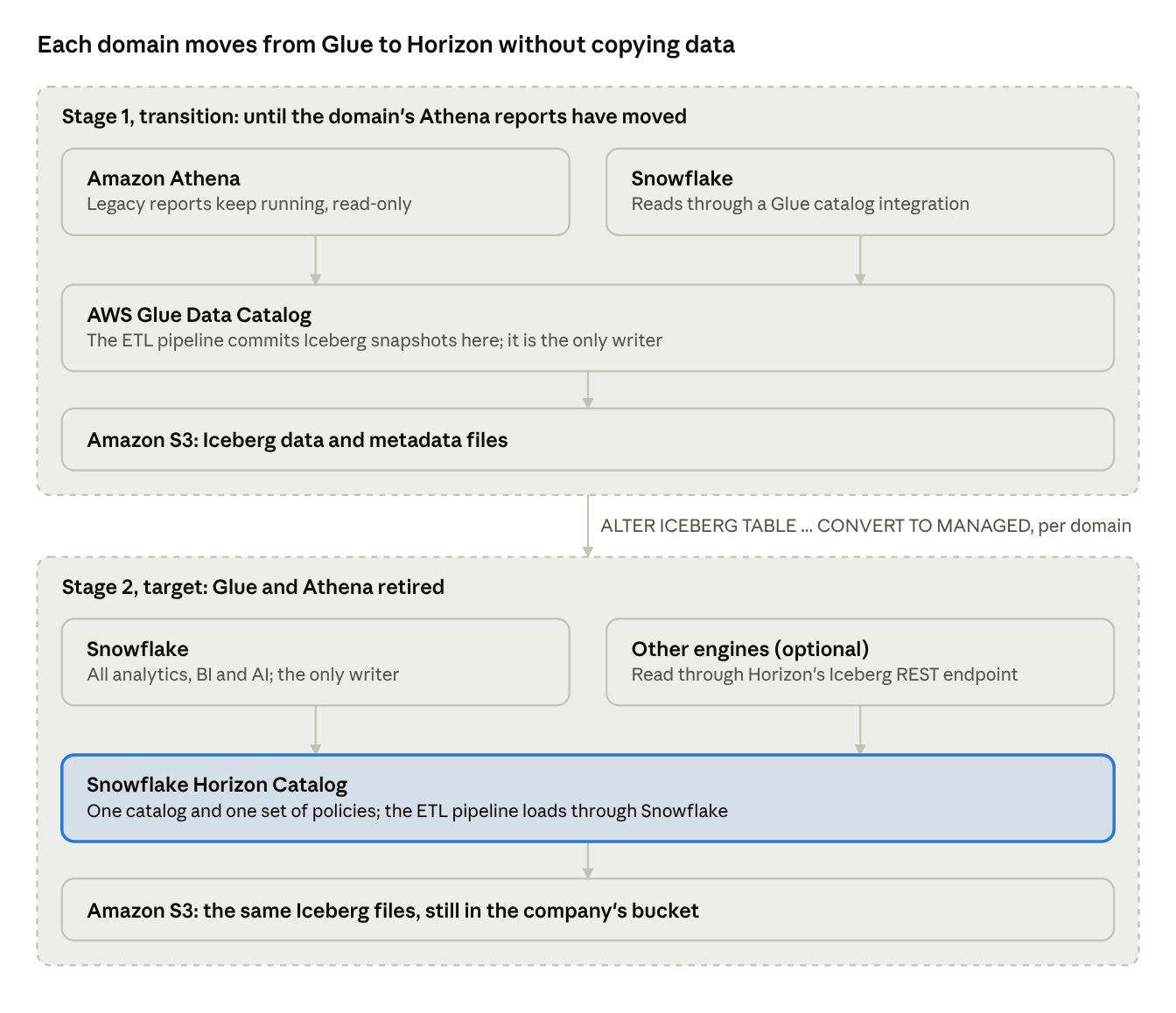
The diagram shows one domain before and after cutover. The data files never move. Only the catalog that tracks them changes, from Glue to Horizon.

04. Key design decisions
 Horizon is the destination, Glue is a bridge.
Every choice is checked against the end state. Nothing new is built on Glue that would outlive cutover.
 Each table has one writer at every stage.
Before cutover, the ETL pipeline commits through Glue and Snowflake only reads. After cutover, Snowflake is the only system that commits. The ETL pipeline either drops files that Snowflake loads, or writes through Horizon’s Iceberg REST endpoint if the ETL tool supports it.
 Reports decide when a domain cuts over.
A domain’s tables are converted only after its Athena reports have been rebuilt and validated in Snowflake. Once a table is converted, Glue no longer sees its new snapshots.
 No data rewrites.
Parquet becomes Iceberg by registering the existing files where possible. Each Glue-cataloged Iceberg table then becomes Snowflake-managed with CONVERT TO MANAGED. The files stay in the company’s own S3 bucket, in an open format.
 Governance and regions move with each domain.
Horizon policies (masking, row access and lineage) replace IAM and Lake Formation rules as each domain moves. A Snowflake account in the same AWS region as each lake keeps data in its jurisdiction and avoids transfer costs. Snapshot retention is set to meet audit requirements.

05. Implementation
The code below uses illustrative table names, not the client’s schemas. Before rollout, confirm each feature is available in the account’s region.
 Stage 1: Convert to Iceberg in Glue, and let Snowflake read.
Athena rewrites small tables with CTAS. Large tables are registered in place with Iceberg’s add_files procedure, so no data is copied.
-- Athena CREATE TABLE clinical.lab_results_ice WITH (table_type = 'ICEBERG', is_external = false, location = 's3:///iceberg/lab_results/', partitioning = ARRAY['month(collected_at)']) AS SELECT * FROM clinical.lab_results; -- Snowflake: read the same table through Glue -- (lake_vol is an external volume pointing at the lake bucket) CREATE CATALOG INTEGRATION glue_cat CATALOG_SOURCE = GLUE CATALOG_NAMESPACE = 'clinical' TABLE_FORMAT = ICEBERG GLUE_AWS_ROLE_ARN = 'arn:aws:iam:: :role/snowflake-glue-read' GLUE_CATALOG_ID = ' ' GLUE_REGION = ' ' ENABLED = TRUE; CREATE ICEBERG TABLE lab_results EXTERNAL_VOLUME = 'lake_vol' CATALOG = 'glue_cat' CATALOG_TABLE_NAME = 'lab_results_ice' AUTO_REFRESH = TRUE;
 Stage 2: Cut over to Horizon, one domain at a time.
This happens only after the domain’s reports are validated in Snowflake:
-- Snowflake takes ownership of the catalog; data files stay in place
ALTER ICEBERG TABLE lab_results CONVERT TO MANAGED
  BASE_LOCATION = 'clinical/lab_results/';

-- The ETL pipeline now drops files that Snowflake loads
COPY INTO lab_results
  FROM @etl_landing/lab_results/
  FILE_FORMAT = (TYPE = PARQUET)
  MATCH_BY_COLUMN_NAME = CASE_INSENSITIVE;
 Rollout
Foundation. Convert pilot tables to Iceberg in Glue. Point Athena at them, connect Snowflake, and check that row counts and key aggregates match exactly in both engines.
Report migration. Rebuild each domain’s Athena reports in Snowflake. Run old and new side by side until the outputs match, and keep the comparison as validation evidence.
Cutover. Convert the domain’s tables to Snowflake-managed, switch its ETL feed to load through Snowflake, and remove that domain’s Athena access.
Decommission. After the last domain moves, retire the Glue Data Catalog and Athena. Any other engines that still need the data read it through Horizon’s Iceberg REST endpoint.

06. Expected outcomes
These are the engagement’s targets, not yet measured results. We will publish the actual figures once the first domains have cut over.
| Outcome | Target | How we will measure it |
|---|---|---|
| One copy of regulated data | No duplicate copy at any stage of the migration | Storage inventory at each phase |
| No disruption to legacy reporting | Report outputs match exactly before each cutover | Automated output comparison, kept as validation evidence |
| Glue and Athena retired | Each domain cuts over without copying any data files | Number of domains cut over; data files copied at cutover |
| One governance model | Access policies defined once, in Horizon | Policy inventory before and after |
| Lower pipeline cost | No pipelines that exist only to copy data between platforms | Pipeline count and run cost |
| No lock-in | Data stays as Iceberg files in the company’s own S3 bucket | Other engines can read it through Horizon’s REST endpoint |

07. Why Snowflake, and what comes next
Snowflake can start as a reader on another platform’s catalog and later take ownership of the same tables without moving the data. That is what makes this migration incremental instead of all at once. The company keeps its data in open Iceberg format in its own S3 bucket. It ends with one platform and one governance model in Horizon, with elastic compute, data sharing across business units and partners, and built-in AI.
With clinical, manufacturing and commercial data governed in one place, we will cover next article how to build a Snowflake Intelligence agent with a semantic view and Cortex Search, so business users can ask questions in plain English.